Ocean freight rates can feel impossible to understand from the outside.
One week a 40-foot container from Asia to the U.S. may look affordable. The next week, the same lane may move higher because of capacity pressure, fuel adjustments, blank sailings, port congestion, peak season demand, or general rate increases. For importers, this creates a serious problem: you cannot calculate landed cost, compare suppliers, or price inventory correctly unless you know what the freight side may cost.
That is why lane-level ocean rate visibility matters.
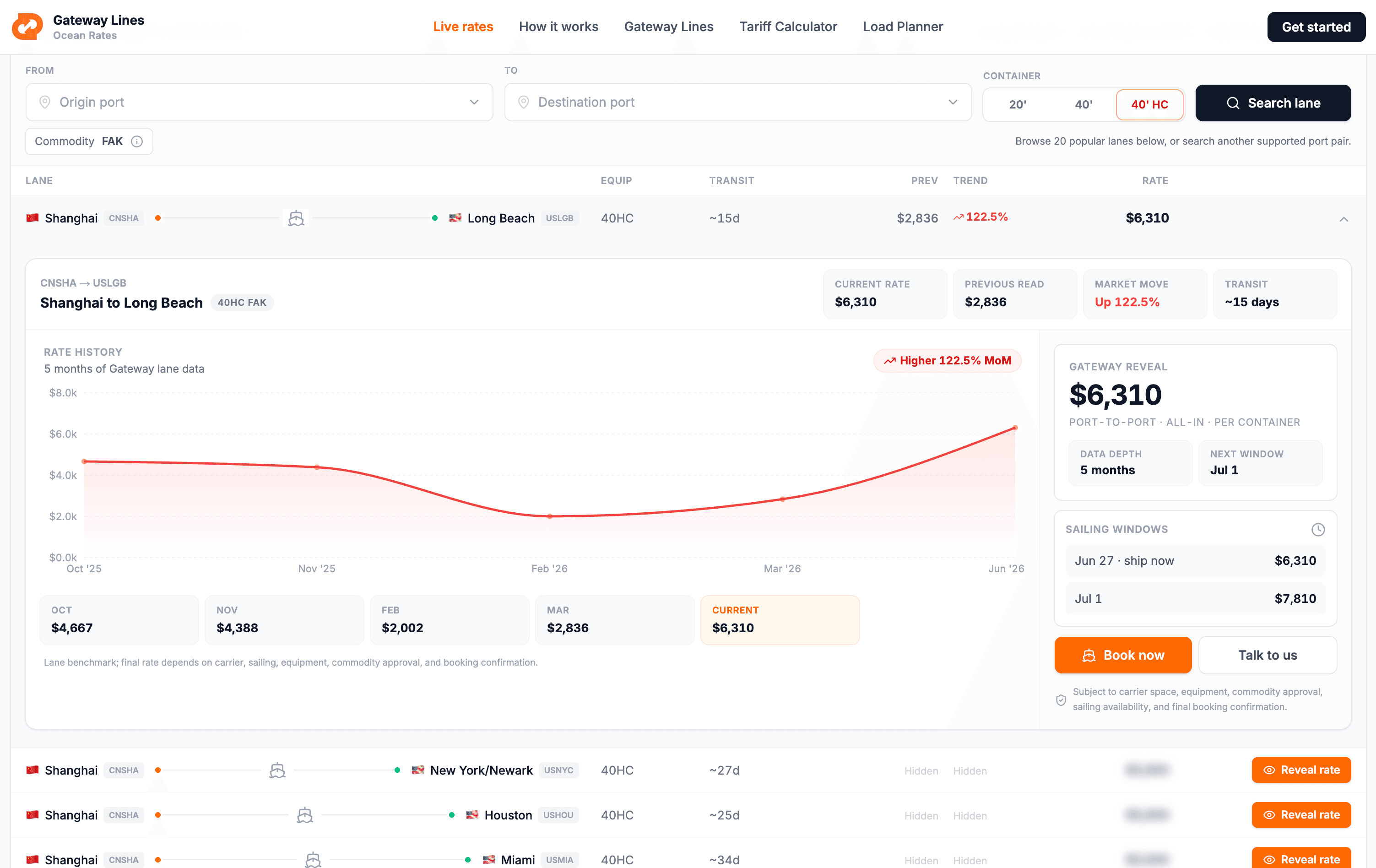
Instead of relying only on outdated spreadsheets, broad market averages, or slow quote requests, importers can now check current FCL spot rates by lane using the Gateway Lines Ocean Rates board:
Check live ocean freight rates by lane →
This guide explains how ocean freight rates work, what affects container pricing, and how to use live rate tools to make better import decisions before booking.
What Are Ocean Freight Rates?
Ocean freight rates are the charges paid to move cargo by sea from one port to another. For full-container shipments, the rate is usually quoted per container.
Common container sizes include:
- 20-foot container
- 40-foot container
- 40-foot high-cube container
A shipper moving goods from Shanghai to Long Beach, Ningbo to New York, Shenzhen to Savannah, or Qingdao to Houston will typically compare rates by lane, equipment type, commodity, transit time, and sailing availability.
For most general cargo, importers often see FAK rates, which means Freight All Kinds. FAK pricing is used for many general commodities that do not require special handling, temperature control, hazardous classification, oversize equipment, or commodity-specific pricing.
In simple terms: an ocean freight rate tells you what it may cost to move one container from an origin port to a destination port.
But the number itself is only one part of the shipment decision.
A real import cost picture should also consider tariffs, duties, customs clearance, insurance, drayage, destination charges, documentation, and possible delays.
Why Ocean Freight Rates Change So Often
Ocean freight rates are not fixed forever. They move with the market.
A rate can change because of:
1. Vessel Capacity
When there is more cargo than available vessel space, rates usually rise. When carriers have more capacity than demand, rates may soften.
2. Fuel Costs
Marine fuel costs can influence bunker adjustment factors, commonly called BAF. These fuel-related adjustments may be included in all-in rate structures or shown separately depending on the quote.
3. Port Congestion
Congestion at major ports can affect vessel schedules, equipment availability, and carrier pricing.
4. Peak Season
Importers often ship heavily before retail seasons, holidays, construction cycles, and inventory deadlines. When demand increases, rate pressure can follow.
5. General Rate Increases
Carriers may announce general rate increases, often called GRIs, when market conditions support higher pricing.
6. Equipment Availability
A rate is not useful if the correct equipment is unavailable. A 40-foot high-cube container may price differently from a standard 40-foot container depending on demand and availability.
7. Lane-Specific Demand
Ocean freight is not one global price. Rates differ by lane. China to U.S. West Coast, China to U.S. East Coast, Vietnam to Savannah, India to New York, and Europe to Houston can all behave differently.
That is why a lane-level tool is more useful than a generic global freight index for many importers.
Why Importers Should Check Rates by Lane
A lane is the specific route between an origin and destination.
For example:
- Shanghai to Long Beach
- Ningbo to New York
- Shenzhen to Savannah
- Qingdao to Houston
- Yantian to Los Angeles
- Busan to Seattle
- Rotterdam to New York
- Nhava Sheva to Houston
Two lanes can move in different directions at the same time. A global ocean freight headline may say rates are rising, but your specific lane may be flat. Or the market may look calm globally while your port pair is tightening because of equipment imbalance, port congestion, or seasonal volume.
This is why importers should avoid making decisions from broad averages alone.
A lane-level rate helps answer:
- What does this route cost right now?
- Is the rate trending up or down?
- Is the difference between a 20-foot and 40-foot container meaningful?
- Should I ship now or wait?
- Should I compare another destination port?
- Should I ask for a confirmed quote before placing the purchase order?
The earlier you check ocean rates, the better your landed cost estimate becomes.
How to Check Live Ocean Freight Rates with Gateway Lines
Gateway Lines built a dedicated ocean rate board for importers who want a faster way to view current FCL spot rates by lane.
You can access it here: oceanrates.gatewaylines.com
The Gateway Lines Ocean Rates board lets users search supported port pairs and review daily FCL FAK spot rates for major lanes. Users can search by origin port, destination port, and container size, then reveal lane-level rate information.
The tool is designed for importers who want to understand the freight side before they request a full booking or shipment review.
A typical workflow looks like this:
- Choose the origin port.
- Choose the destination port.
- Select 20-foot, 40-foot, or 40-foot high-cube.
- Search the lane.
- Review the current rate context.
- Use the result to request a confirmed quote or talk to Gateway Lines.
The rate board is especially useful when paired with other import planning tools, such as tariff calculation, load planning, and landed cost analysis.
Ocean Freight Rate vs. Final Freight Quote
A live ocean freight rate is a strong starting point, but it is not always the final all-in shipment cost.
A rate board can help you understand the current port-to-port market. A final freight quote should confirm the details that matter for your specific shipment.
Those details may include:
- Commodity
- Container size
- Cargo weight
- Cargo dimensions
- Origin port
- Destination port
- Sailing window
- Equipment availability
- Carrier space
- Incoterms
- Hazardous or non-hazardous classification
- Overweight limits
- Insurance
- Customs clearance
- Drayage and inland delivery
- Destination fees
- Documentation requirements
For example, a port-to-port FCL rate may not include final-mile delivery from the destination port to your warehouse. It may also exclude customs brokerage, duties, tariffs, cargo insurance, exams, storage, demurrage, detention, or other shipment-specific charges.
That is why a smart importer uses an ocean rate board for early planning, then requests a confirmed quote before booking.
What Goes Into an FCL Ocean Freight Rate?
An FCL ocean freight rate may include several cost components.
Base Ocean Freight
This is the core charge to move a container from the origin port to the destination port.
BAF
BAF stands for bunker adjustment factor. It is related to marine fuel costs.
THC
THC stands for terminal handling charge. It covers terminal handling activity at ports.
PSS
PSS stands for peak season surcharge. It may apply when demand increases during busy shipping periods.
GRI
GRI stands for general rate increase. Carriers may apply GRIs when market conditions support higher pricing.
Documentation and Booking Fees
Depending on the quote structure, documentation or booking-related charges may appear separately.
Destination Charges
These may include destination terminal, handling, documentation, delivery order, chassis, port, or other local charges depending on the shipment and provider.
This is why importers should not compare only the headline ocean number. A lower base rate can become more expensive if other charges are unclear.
20-Foot vs. 40-Foot vs. 40-Foot High-Cube Rates
Container size matters.
A 20-foot container is often used for dense or heavy cargo. It has less cubic capacity but may work well for products with high weight and low volume.
A 40-foot container gives more space and is common for general cargo.
A 40-foot high-cube container offers extra vertical capacity and is often preferred for lighter, bulkier goods such as furniture, home goods, packaging, consumer products, and certain retail inventory.
Importers should not choose container size based only on rate. They should consider:
- Total cargo volume
- Total cargo weight
- Palletization
- Carton dimensions
- Loadability
- Destination weight limits
- Product fragility
- Cost per unit shipped
- Whether the shipment can fit into one container
A slightly higher container rate may still produce a lower cost per unit if the container fits more sellable inventory.
That is why ocean rate checking should connect to load planning.
Why Ocean Rates Matter for Landed Cost
Landed cost is the total estimated cost to bring goods into your warehouse or final destination.
It may include:
- Product cost
- Ocean freight
- Duties and tariffs
- Customs fees
- Harbor maintenance fee
- Merchandise processing fee
- Customs brokerage
- ISF filing
- Cargo insurance
- Drayage
- Warehousing
- Delivery
- Demurrage or detention risk
- Compliance-related charges
Ocean freight can materially change landed cost, especially when rates move quickly.
For example, if an importer is comparing suppliers in China, Vietnam, India, Turkey, or Mexico, the product price alone is not enough. The importer should also compare:
- Duty rate
- Special tariffs
- Ocean freight rate
- Transit time
- Container utilization
- Customs complexity
- Delivery cost
- Reliability
Gateway's broader import workflow is built around this idea: freight decisions should connect to tariff exposure, landed cost, container planning, customs clearance, and shipment execution.
The ocean rate is only one number, but it is a critical number.
How Importers Can Use Ocean Freight Rates Before Buying Inventory
Ocean freight rates should not be checked only after cargo is ready.
The best time to check rates is before you commit to the purchase order.
Here is how importers can use rate visibility earlier:
Compare Supplier Countries
If the same product can be sourced from multiple countries, the ocean freight rate may change the true landed cost.
Compare Ports
Sometimes routing through a different port may change cost, transit time, or reliability.
Estimate Cost Per Unit
Importers can divide estimated freight cost by units per container to understand freight impact per unit.
Plan Inventory Timing
If rates are rising or capacity is tightening, importers may choose to book earlier.
Avoid Bad Quote Comparisons
A rate board gives a reference point before comparing quotes from freight providers.
Improve Negotiation
Importers with current lane visibility can ask better questions and avoid vague pricing.
The goal is not just to find the cheapest rate. The goal is to understand the real cost and risk before cargo moves.
Common Mistakes Importers Make When Comparing Ocean Freight Rates
Mistake 1: Comparing Different Container Sizes
A 20-foot rate and a 40-foot high-cube rate are not interchangeable. Always compare the same equipment type.
Mistake 2: Ignoring Destination Charges
A cheap ocean rate may not include destination fees, drayage, customs, exams, storage, or other local charges.
Mistake 3: Not Confirming Space
A rate is only useful if space and equipment can be confirmed.
Mistake 4: Forgetting Tariffs
Ocean freight is only one part of landed cost. Tariffs may exceed freight cost, especially for certain China-origin products or goods affected by special trade actions.
Mistake 5: Waiting Until Cargo Is Ready
If you wait until the shipment is ready to load, you may have fewer sailing options and less time to solve documentation problems.
Mistake 6: Choosing the Cheapest Provider Without Accountability
Freight is not just a price. Importers also need documentation accuracy, responsive communication, tracking, customs coordination, and problem-solving when something changes.
When Should You Request a Confirmed Ocean Freight Quote?
You should request a confirmed quote when you have enough shipment details to move from estimate to execution.
That usually means you know:
- Product or commodity
- Origin city or port
- Destination port or warehouse ZIP code
- Cargo ready date
- Container size or cargo dimensions
- Gross weight
- Commercial invoice value
- Incoterms
- Whether the shipment is FCL or LCL
- Any special handling needs
If you do not know the container size yet, you can still begin with dimensions and weight. Gateway can help review whether the cargo is more likely to move as FCL, LCL, or another freight mode.
For importers using Gateway Lines Ocean Rates, the next step after checking a lane is to request a confirmed freight quote or speak with Gateway about the shipment.
Start here: Check your ocean freight lane →
Ocean Freight Rates from China to the United States
Many U.S. importers search ocean freight rates from China to the United States because China remains one of the most important sourcing origins for consumer goods, industrial materials, machinery, furniture, electronics, packaging, and general merchandise.
Popular China-to-U.S. ocean freight lanes may include:
- Shanghai to Long Beach
- Ningbo to New York
- Shenzhen to Savannah
- Qingdao to Houston
- Yantian to Los Angeles
- Xiamen to Seattle
For China-origin imports, freight is only one part of the cost equation. Importers should also check:
- HTS classification
- Base duty
- Section 301 tariff exposure
- Possible antidumping or countervailing duties
- Customs documentation
- ISF requirements
- Cargo insurance
- Drayage and final delivery
This is why importers should connect ocean rate visibility with tariff calculation and landed cost planning.
A container rate may look attractive, but the landed cost may still be high if duties and tariffs are significant.
Why Live Ocean Freight Rates Are Better Than Static Rate Sheets
Static rate sheets can become outdated quickly.
A live or frequently updated rate board gives importers a better planning tool because it reflects current lane conditions more closely than old PDFs or email attachments.
Live rate tools help importers:
- Check rates faster
- Compare lanes more easily
- Understand current market direction
- Avoid waiting days for a basic benchmark
- Start quote conversations with better context
- Improve landed cost estimates
- Make sourcing and timing decisions earlier
For many importers, this is the difference between guessing and planning.
Gateway Lines Ocean Rates was built around that need: faster lane-level visibility for FCL ocean freight.
How Gateway Lines Connects Ocean Rates to the Import Workflow
The best freight decision is not made from a rate alone.
Importers need a connected workflow:
- Check ocean freight rates.
- Calculate tariffs and duties.
- Estimate landed cost.
- Plan the container.
- Confirm booking.
- Prepare documents.
- Start customs clearance.
- Track the shipment.
- Coordinate delivery.
- Review final cost.
Gateway Lines is building around that full import path.
The Ocean Rates board helps answer the first big freight question: what does this container lane cost right now?
From there, importers can move into quote confirmation, tariff review, customs workflow, container planning, and shipment execution.
FAQ: Ocean Freight Rates
How much does ocean freight cost per container?
Ocean freight cost depends on the lane, container size, cargo type, season, capacity, fuel, and timing. A 20-foot container, 40-foot container, and 40-foot high-cube container can each price differently on the same lane.
Where can I check live ocean freight rates?
You can check current FCL ocean freight rates by lane using Gateway Lines Ocean Rates at oceanrates.gatewaylines.com.
What is an FCL rate?
FCL stands for full container load. An FCL rate is the cost to move a full container from one port to another.
What is a FAK ocean freight rate?
FAK means Freight All Kinds. It is a general cargo rate used for many standard commodities. Special cargo, hazardous goods, refrigerated cargo, overweight freight, or restricted commodities may require different pricing.
Do ocean freight rates include customs duties?
Usually no. Ocean freight rates are separate from customs duties, tariffs, taxes, customs brokerage, insurance, drayage, and other import costs unless a quote clearly states otherwise.
Why do ocean freight rates change?
Rates change because of vessel capacity, equipment availability, fuel costs, port congestion, peak season, general rate increases, and lane-specific demand.
Is the cheapest ocean rate always the best?
No. Importers should compare the full quote structure, included charges, transit time, sailing reliability, documentation support, customs workflow, and provider accountability.
When should I check ocean freight rates?
Check rates before placing the purchase order, again before cargo is ready, and once more before booking. Early rate visibility helps improve landed cost planning.
Final Takeaway
Ocean freight rates are one of the most important numbers in international shipping, but they should not be viewed in isolation.
A smart importer checks the rate by lane, confirms the container size, reviews tariff exposure, estimates landed cost, and requests a confirmed quote before booking.
Gateway Lines Ocean Rates gives importers a faster way to start that process.
Use the live rate board here: oceanrates.gatewaylines.com
Check your lane, compare container options, understand the market, and move from freight estimate to confirmed shipment with Gateway Lines.