In ocean freight, the term NVOCC appears frequently, yet it is often misunderstood. While shippers regularly interact with carriers, forwarders, and brokers, the role of an NVOCC is less clearly defined despite being central to how containerized cargo moves globally.
Understanding what an NVOCC is—and how it differs from other participants in ocean trade—helps clarify how freight is booked, documented, and executed across international supply chains.
Definition of an NVOCC
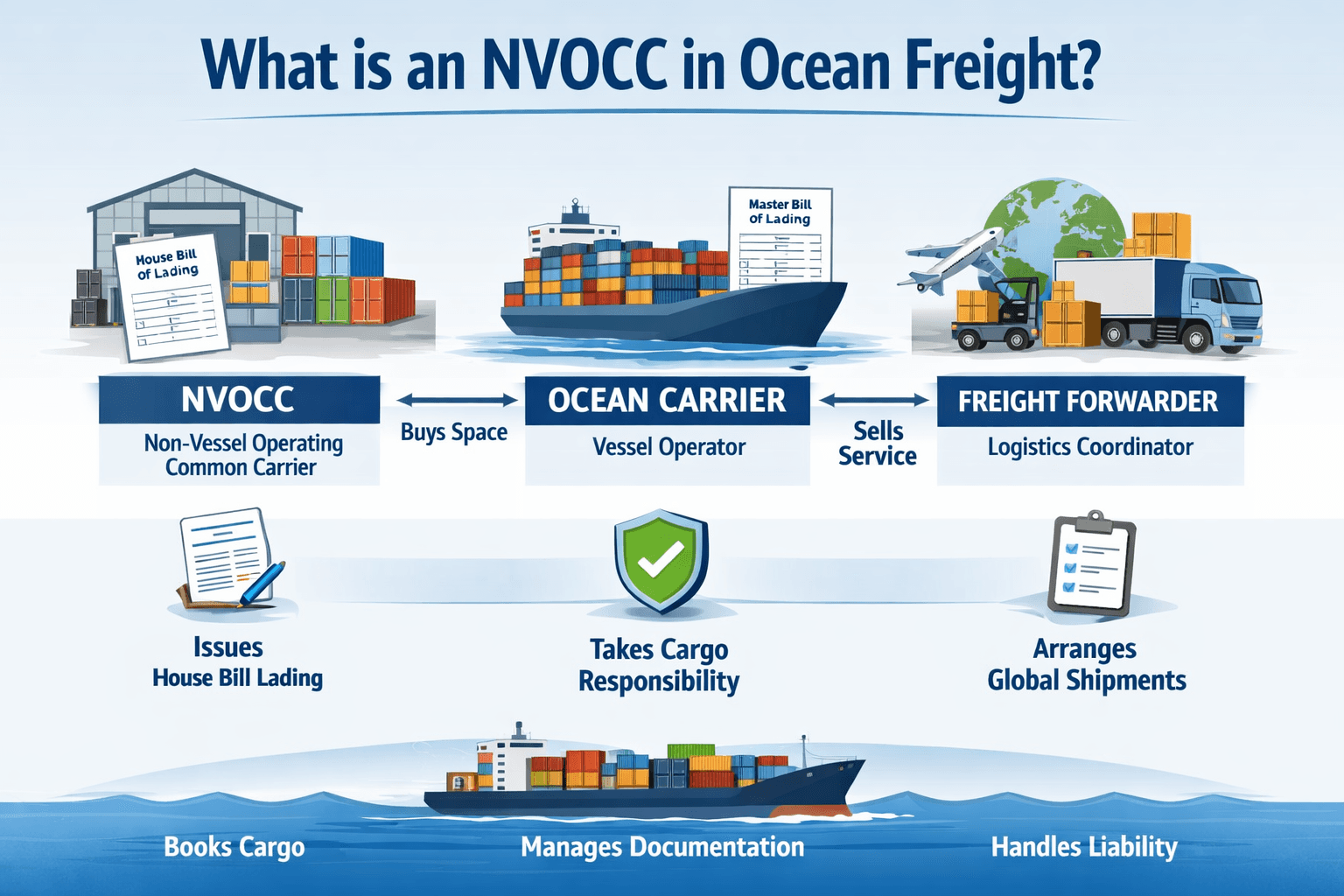
An NVOCC, or Non-Vessel Operating Common Carrier, is a licensed ocean transportation intermediary that provides ocean freight services without operating its own vessels.
An NVOCC:
Buys space from ocean carriers
Sells ocean transportation services to shippers
Issues its own bills of lading
Assumes responsibility for the cargo it moves
Although it does not own ships, an NVOCC functions as a carrier from a legal and contractual perspective.
How NVOCCs Fit into Ocean Trade
In a typical ocean shipment, cargo moves across multiple layers of responsibility. Ocean carriers operate vessels and control sailing schedules. Ports and terminals handle loading and discharge. Inland providers move cargo before and after the ocean leg.
An NVOCC sits between the shipper and the vessel-operating carrier, coordinating transportation while managing documentation, liability, and customer relationships.
From the shipper’s perspective, the NVOCC may appear to be the carrier, even though the physical movement is performed by an underlying vessel operator.
NVOCC vs Ocean Carrier
The key distinction between an NVOCC and an ocean carrier lies in vessel ownership and operation.
Ocean carriers:
Own or charter vessels
Control sailing schedules
Physically transport containers across oceans
NVOCCs:
Do not operate vessels
Purchase space from carriers
Aggregate, manage, and resell capacity
Despite these differences, both issue bills of lading and are legally responsible for cargo under their respective contracts.
NVOCC vs Freight Forwarder
The difference between an NVOCC and a freight forwarder is often misunderstood.
A freight forwarder acts as an agent on behalf of the shipper, arranging transportation and services but generally not assuming carrier liability.
An NVOCC, by contrast:
Acts as a principal, not just an agent
Issues its own house bill of lading
Assumes carrier-level responsibility for the shipment
Some companies operate as both freight forwarders and NVOCCs, depending on the services provided and the structure of the transaction.
Regulatory Oversight
In the United States, NVOCCs are regulated by the Federal Maritime Commission (FMC). To operate legally, an NVOCC must:
Obtain an FMC license
Maintain a financial responsibility bond
Publish and maintain tariffs
Comply with recordkeeping and reporting requirements
Other countries maintain similar regulatory frameworks to ensure financial responsibility and consumer protection.
Bills of Lading and Liability
One of the defining features of an NVOCC is its ability to issue a house bill of lading. This document governs the contractual relationship between the NVOCC and the shipper.
At the same time, the NVOCC receives a master bill of lading from the vessel-operating carrier.
This dual documentation structure means:
The shipper’s contract is with the NVOCC
The NVOCC’s contract is with the carrier
Liability is managed across both relationships
Understanding this distinction is critical in claims, disputes, and cargo insurance scenarios.
Why NVOCCs Exist
NVOCCs emerged to address practical realities in global trade. Many shippers lack the scale, expertise, or infrastructure to contract directly with carriers across multiple trade lanes.
By aggregating demand, managing documentation, and coordinating execution, NVOCCs simplify access to ocean transportation while providing flexibility in routing, scheduling, and service models.
Common Misconceptions
A frequent misconception is that NVOCCs merely resell carrier space without adding operational responsibility. In reality, NVOCCs carry contractual obligations similar to carriers and are subject to regulatory oversight.
Another misconception is that NVOCCs and freight forwarders are interchangeable. While some firms perform both roles, the legal and operational distinctions remain significant.
Conclusion
NVOCCs play a foundational role in modern ocean trade. They bridge the gap between shippers and vessel operators, manage liability through documentation, and provide access to global ocean transportation without operating ships themselves.
Understanding how NVOCCs function—and how they differ from carriers and forwarders—provides clarity into the structure of containerized trade and the responsibilities behind every ocean shipment.